 Aimatra
simulation
AimatraLab Alloy Builder
Atomic structure modeling for high-entropy materials: build all-site alloy or selected-sublattice models from multi-element ratios, inspect SRO and 3D structures, and export complete models for downstream calculations. V2.0.2 showcase only; V1.1.0 download requires sign-in, and calculation requires this product’s machine-bound license. Occupation search does not calculate energies or relax structures; downstream validation remains necessary.
V2.0.2 showcase only — not open for download
New V1.1.0 calculations require a machine-bound license for this product; website sign-in and application activation are separate.
Overview
Multi-component atomic models for high-entropy materials
Turn elemental ratios into atomic arrangements you can inspect and export, preparing periodic models for high-entropy alloys and multi-component studies on a selected sublattice.
1 · Set composition
Set equal or unequal elemental ratios and a supercell; compare target fractions with the actual integer atom counts in a finite model.
2 · Build atomic arrangements
Optimize occupations across alloy sites; V2 also lets you select one mixed sublattice while retaining the other atoms.
3 · Inspect mixing and structure
Inspect signed Warren–Cowley SRO, search history and the 3D model to check pair statistics in the selected neighbour shells.
4 · Export for the next calculation
Export complete POSCAR, CIF, extXYZ and result data; V2 sublattice mode also provides a full site map for traceability.
High-entropy alloy modelling · Downloadable V1.1.0
Start from FCC / BCC / HCP templates or POSCAR geometry, set multi-element ratios and a supercell, then optimize the arrangement across all sites.
The native SCRAPs C++ Hybrid Cuckoo Search reassigns elements on fixed cell geometry and coordinates, with objective history, SRO, 3D inspection and complete structure/data exports.
High-entropy sublattice modelling · V2.0.2 showcase
For models that mix several elements on one sublattice: import an ordered, fully occupied CIF / POSCAR, explicitly select one active site pool and assign its target composition.
sqsgenerator 0.5.6 optimizes SQS pair statistics on the selected sites. Other site species, all coordinates, the cell and periodic boundaries stay unchanged. V2.0.2 is a showcase only and is not open for download.
Exported models prepare inputs for subsequent calculations. Choose a suitable downstream method for relaxation, energy or property validation; occupation and SRO checks do not establish thermodynamic stability.
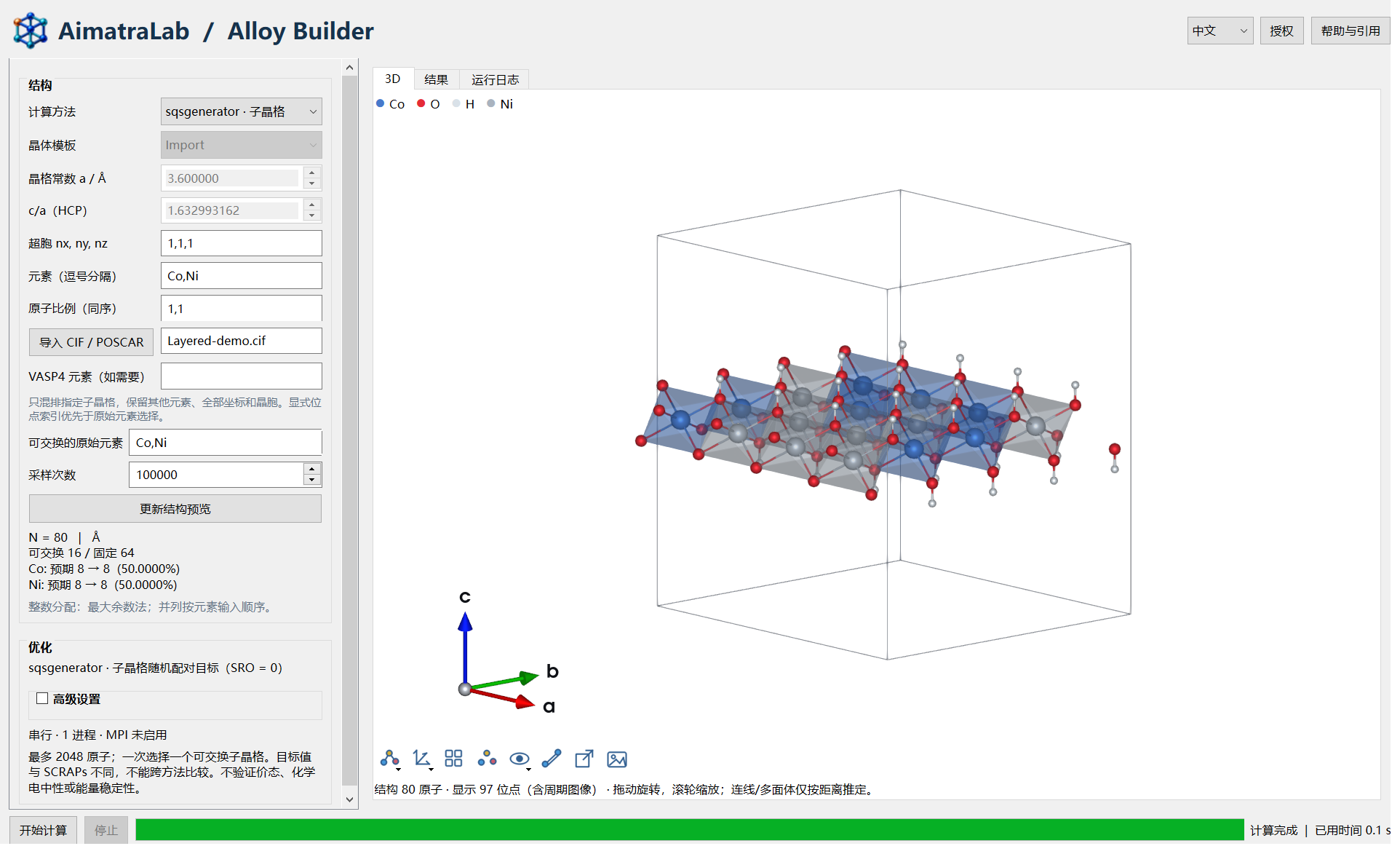
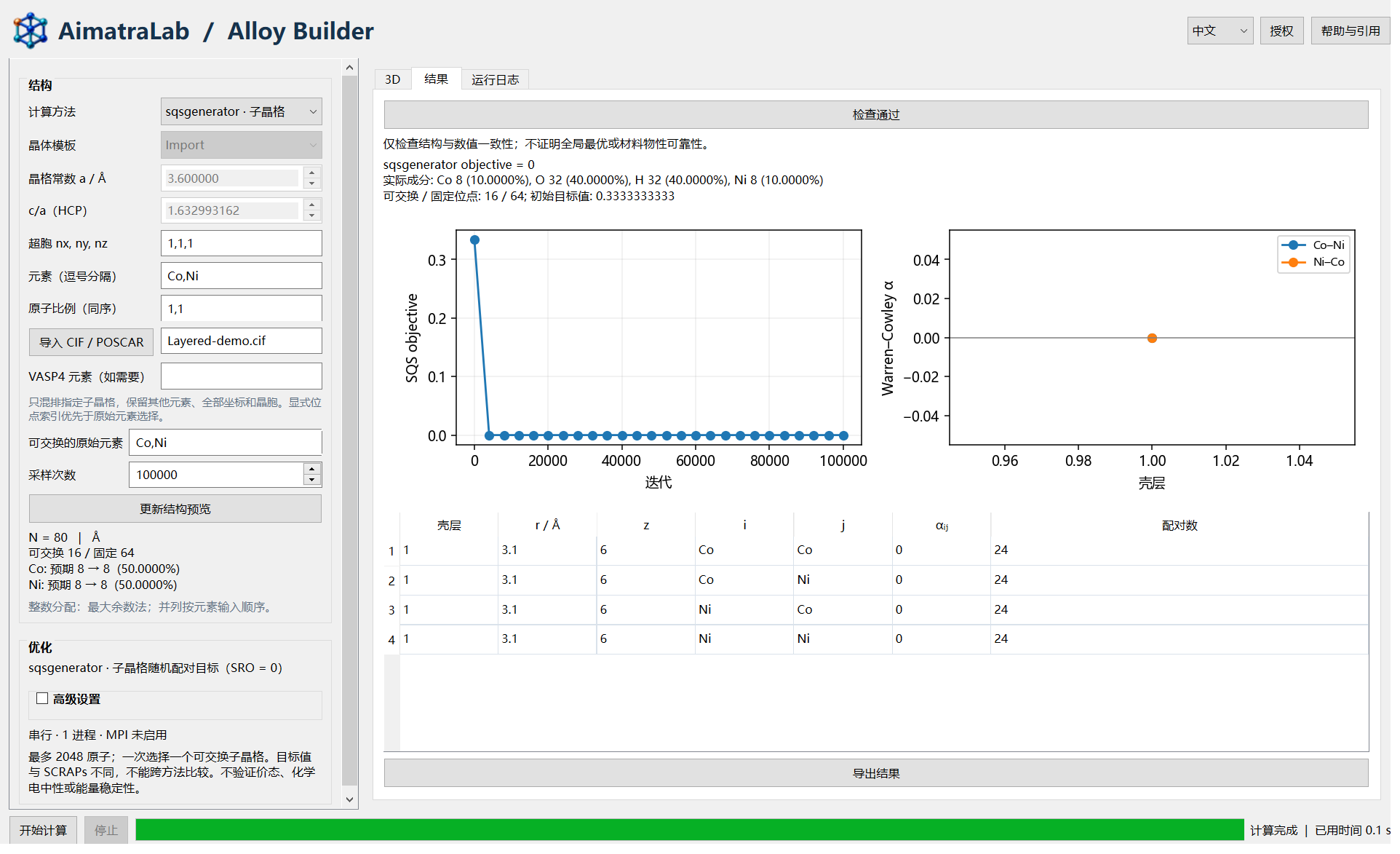
These screens show V2.0.2; downloadable V1.1.0 does not include the sublattice method or the updated display tools.
Model, settings & limits
The all-site alloy path uses native SCRAPs C++ Hybrid Cuckoo Search; the V2 single-active-sublattice path uses sqsgenerator 0.5.6. Both optimize occupations on fixed geometry, without energy calculation, structure relaxation or property prediction. Hamilton largest remainders only allocate composition ratios to integer atom counts.
Each input must pass import, coordination and periodic-adjacency checks. One active pool shares one target composition; multiple independently constrained pools are not exposed. A high-entropy modelling purpose does not establish chemical plausibility or high-entropy stability for every element combination.
Supports 2–2048 fully periodic sites, 2–8 target elements and up to five shells, each with uniform nonzero coordination. Positive ratios become integer populations through Hamilton largest remainders; inspect actual composition. The HCP template is a close-packed atomic lattice.
SCRAPs exposes population, MC and global/local search budgets, seed and shell weights. Sublattice mode exposes sampling budget, seed, shells and weights, with a default distance-clustering tolerance of 0.03 Å. Larger budgets do not guarantee zero error or a fixed runtime. Both methods use one serial native worker.
Sublattice import rejects partial/mixed occupancy, disorder and ambiguous CIFs; Selective Dynamics constraints are unsupported. Native sqsgenerator adjacency must match the full periodic-image graph. Unrepresentable repeated-image bonds or self images are rejected; fewer shells or an explicitly enlarged cell may be required.
Strict V2 checks may conservatively reject some equivalent lattice-wrap representations at exact boundary coordinates. These checks were not weakened; arbitrary CIF input is not guaranteed to succeed.
The two methods use different objective functions, so their values are not directly comparable. Signed SRO is retained; finite cells may not reach zero. A validation badge records structural and numerical consistency checks; same-seed reproducibility is scoped to the same implementation and environment.
V2.0.2 display tools
Ball-stick, spheres, wireframe and coordination polyhedra; a/b/c or custom [uvw] views, display repetition, element visibility and colours/radii, labels and cell/axis controls, a larger window, and PNG / TIFF image export (transparent backgrounds for PNG only).
Display copies, distance-based links and convex polyhedra affect the view only. They do not change the scientific structure, composition or export, or validate chemical coordination or energy.
Method sources & attribution
The application uses a modified serial SCRAPs derivative; no endorsement by the original authors or institutions is implied. Both backends retain their method and license attribution.
- SCRAPs / Hybrid-Cuckoo-Search
- Singh et al. Accelerating computational modeling and design of high-entropy alloys. Nature Computational Science 1, 54–61 (2021). DOI: 10.1038/s43588-020-00006-7
- sqsgenerator: official SRO and objective definitions
Features
- Prepare high-entropy alloy models from FCC/BCC/HCP templates or POSCAR: set equal or unequal multi-element ratios and a supercell, then inspect actual integer atom populations.
- V2.0.2 showcase: build multi-component occupations on one selected active sublattice of an ordered, fully occupied CIF/POSCAR; preserve the remaining species, all coordinates and the cell.
- Inspect signed Warren–Cowley short-range order (SRO), pair statistics and optimization history against the selected random-mixing target.
- Preview complete structures in 3D. V2 adds element colours, coordination polyhedra, crystal axes and directional views, plus PNG/TIFF image export.
- Export complete POSCAR/CIF/extended-XYZ structures and CSV/JSON records for downstream calculations. V2 also records the full original-to-final site map; choose and validate the downstream physical model separately.
Version history
V2.0.2 showcase only; downloads are not open. Adds the selected-sublattice sqsgenerator workflow and updated crystal viewer. The separate V1.1.0 download uses the original SCRAPs all-site workflow.
V2.0.2 current contact: hello@aimatralab.com
V1.1.0 · Chinese / English · Offline licensed edition · Windows x64 · ZIP · 242.1 MiB
Extract the complete portable package to a short, writable path and run AimatraLab-Alloy-Builder.exe; retain the worker executable and the entire adjacent _internal folder. Keep the complete extracted package together.
The interface starts in Chinese and can switch to English through its language control. Calculations and license verification run locally offline without a separate Python or MPI installation, cloud service or AI API.
New calculations require a machine-bound license for this product. Export the complete machine request JSON file, obtain the issued file through the official contact channel, then import the signed JSON license file in the application. The copied machine-code text alone is insufficient for signing.
Validity follows the issued license. Website sign-in to download and application activation are separate. Activation contact: hello@aimatralab.com
Accepted locally on a Windows 10 x64 workstation; fresh-machine, Windows 11 and other graphics-driver certification was not performed. Offline licensing cannot guarantee tamper resistance or remote revocation. Inspect original inputs and local paths before sharing run records.
Package & checksum
This filename, exact byte count and checksum identify the V1.1.0 main-download customer package.
AimatraLab-Alloy-Builder-1.1.0-win-x64.zip
253812593 bytes
SHA-256: 0f237b6b809a6507ff56a014d428d86fbee8c532a4eade4c0c71d5c82c9cf835
Updates & usage guides
Follow our WeChat and Xiaohongshu accounts for AimatraLab Alloy Builder version updates, tutorials and case studies.
WeChat Official Account
迷之炼金术士
WeChat ID:wband2046

Xiaohongshu
向天歌
Xiaohongshu ID:231054605