 Aimatra
Rate-data input: mA/g versus h⁻¹
Use the site’s existing six-point synthetic teaching dataset, not real experimental data or a material-performance claim. Distinguish original specific current I/m (mA/g) from the measured-capacity-normalised rate R (h⁻¹) used by this model.
Load the teaching example
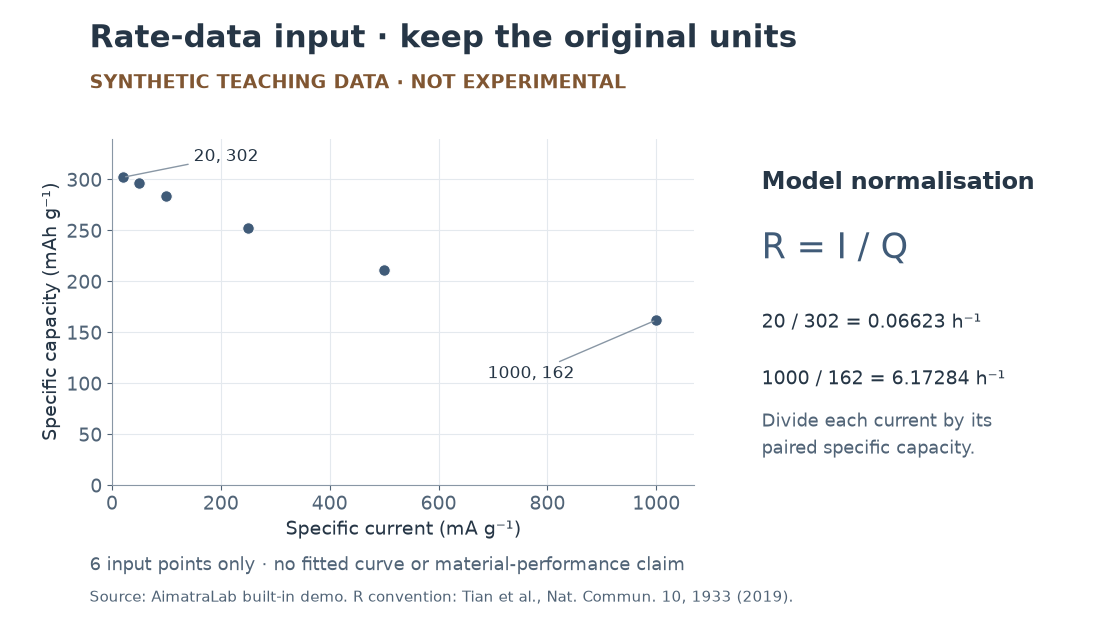
Open rate analysis and choose Load example. The paired specific-current/capacity values are 20/302, 50/296, 100/284, 250/252, 500/211 and 1000/162, in mA/g and mAh/g respectively. The CSV below supports manual reproduction.
Keep the original units
Choose mA/g for current and mAh/g for capacity. Do not relabel 1000 mA/g as 1000 h⁻¹ or convert a value twice.
Understand pointwise R=I/Q
For the Tian characteristic-time model, divide each specific current by its paired measured specific capacity: 20/302=0.06623 h⁻¹ and 1000/162=6.17284 h⁻¹. Convert each point separately. This differs from C-rate defined against a theoretical-capacity reference.
Inspect results and limits
Run the fit and inspect status, used-point count, units and warnings before examining the curve and residuals. Export data and results for a record. Parameters describe the chosen data and model; fit quality alone does not establish a real material’s transport mechanism.
Check your result
- Dataset
- 6 synthetic demo points
- R at lowest current
- 20 / 302 = 0.06623 h⁻¹
- R at highest current
- 1000 / 162 = 6.17284 h⁻¹
How to interpret it
- The figure and CSV are synthetic teaching data, not experimental performance or evidence for a paper.
- mA/g, C-rate and h⁻¹ cannot be exchanged by relabelling; conversion requires the stated capacity basis.
- Model parameters and fit quality alone do not establish diffusion, resistance or another specific limiting mechanism.