 Aimatra
LiFePO₄: from formula to theoretical specific capacity
Reproduce this calculation in the online tool using LiFePO4 and one electron per formula unit. It gives theoretical specific capacity of the active material itself; these are not measured battery results.
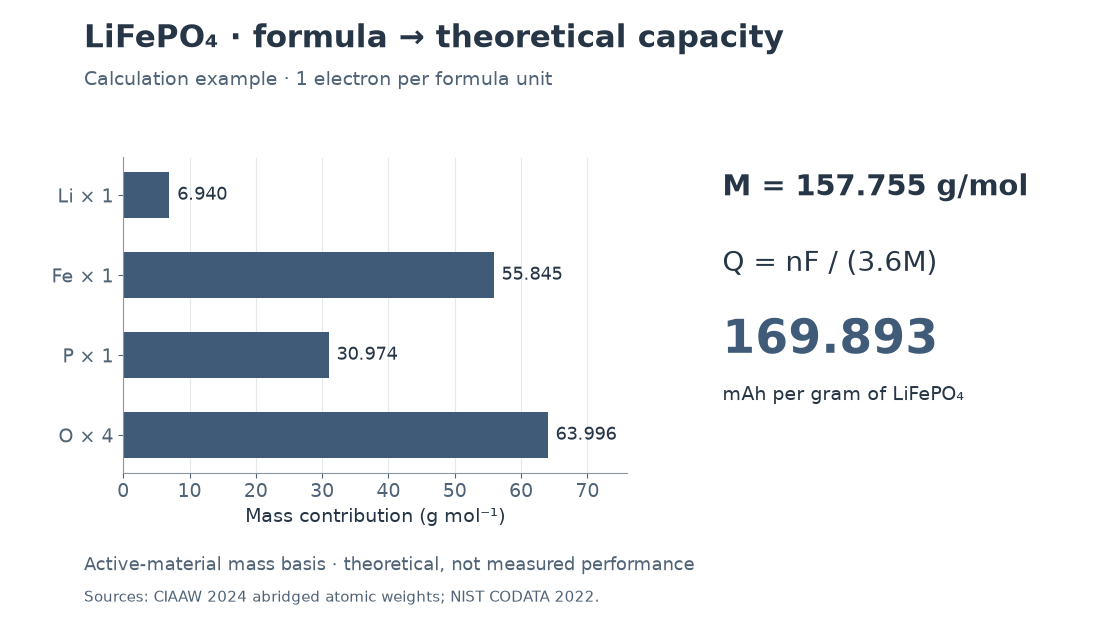
Enter the formula
Open the theoretical-capacity calculator and enter LiFePO4 with the shown capitalisation. To inspect elemental contributions first, enter the same formula in the molecular-weight calculator.
State the electron count
Set the electron count n to 1 and calculate. This is an assumed reaction stoichiometry; the software does not infer the reversible electron count from the formula alone.
Verify mass and equation
M=6.94+55.845+30.974+4×15.999=157.755 g/mol. Q=nF/(3.6M) gives 169.893 mAh/g, commonly rounded to 170 mAh/g.
Match the mass basis before comparison
This value uses pure LiFePO4 active-material mass. If experimental capacity uses total electrode, composite or cell mass, reconcile that denominator before comparison.
Check your result
- Molar mass M
- 157.755 g/mol
- Electrons n
- 1 / formula unit
- Theoretical capacity Q
- 169.893 mAh/g
How to interpret it
- The denominator is active material mass, not total electrode or cell mass.
- This is a theoretical calculation for the stated n=1 assumption; reversibility, voltage window, kinetics and side reactions require experimental assessment.